A Liquid Thermometer Works Because Liquid ______ When Warmed.

loctronix
Mar 15, 2026 · 11 min read
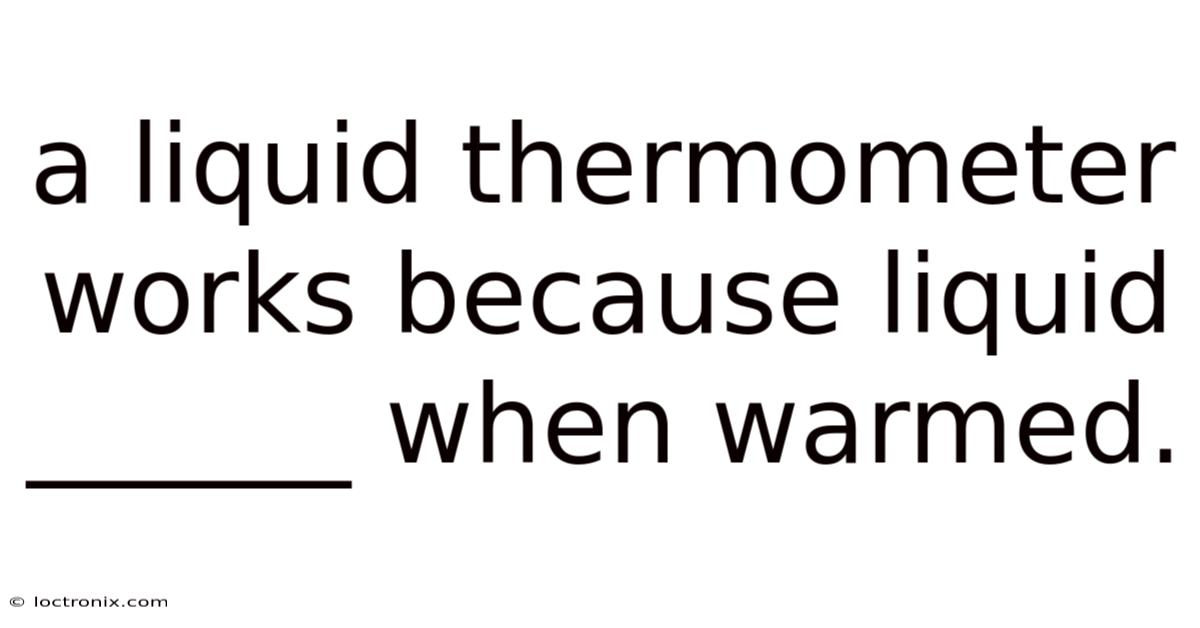
Table of Contents
A Liquid Thermometer Works Because Liquid Expands When Warmed
The simple, elegant glass tube of a liquid thermometer has been a cornerstone of temperature measurement for centuries. Its operation is a direct, visible manifestation of a fundamental physical principle: thermal expansion. A liquid thermometer works because liquid expands when warmed. This seemingly straightforward statement unlocks a world of molecular motion, material science, and precise engineering that allows us to quantify heat with remarkable accuracy. From checking a fever to monitoring industrial processes, this principle translates invisible thermal energy into a readable, linear scale. Understanding why and how this expansion occurs reveals the sophisticated science behind this ubiquitous tool.
The Historical Quest to Measure Heat
Before the standardization of the liquid-in-glass thermometer, attempts to measure temperature were crude and inconsistent. Early devices, like the thermoscope developed by Galileo Galilei in the late 16th century, used air expansion in a sealed tube to move a water column. While a fascinating proof of concept, these were not true thermometers as they lacked a calibrated scale and were highly susceptible to atmospheric pressure changes. The critical innovation was the shift from using air to using a pure liquid as the thermometric fluid. This eliminated the major variable of air pressure, creating a device whose readings depended almost solely on temperature. The adoption of mercury, and later colored alcohol, as the standard liquid cemented the design we recognize today. The historical journey underscores that the core reason a liquid thermometer works—liquid expansion with heat—was identified as the key to reliable, reproducible measurement.
The Molecular Dance: Kinetic Theory and Expansion
At its heart, the expansion of a liquid is driven by the kinetic theory of matter. All matter is composed of atoms or molecules in constant motion. The temperature of a substance is a direct measure of the average kinetic energy of these particles. When a liquid is warmed, thermal energy is transferred to its molecules. This energy causes two primary effects:
- Increased Vibration: Molecules vibrate more intensely around their average positions.
- Increased Separation: The enhanced vibrational motion effectively pushes molecules slightly farther apart on average. While intermolecular forces (attractions between molecules) still hold the liquid together, the increased kinetic energy overcomes these forces just enough to increase the average intermolecular distance.
This increase in the average space between molecules is what we observe macroscopically as expansion. The liquid occupies a larger volume. In the confined, narrow capillary of a thermometer tube, this increased volume has nowhere to go but upward, creating a clear, measurable column. The material of the glass bulb and tube also expands with heat, but because glass has a much lower coefficient of thermal expansion than liquids like mercury or alcohol, its expansion is minimal and predictable, allowing for accurate calibration that accounts for this small effect.
Choosing the Thermometric Liquid: Mercury vs. Alcohol
Not all liquids are suitable for thermometers. The ideal thermometric fluid possesses a specific set of properties:
- High Coefficient of Expansion: It must expand significantly and uniformly with a small temperature change, providing a sensitive and easily readable scale.
- Wide Liquid Range: It should remain liquid over a broad temperature span, from well below freezing to above boiling.
- Visibility: It must be clearly visible against the glass.
- Chemical Inertness: It should not react with or wet the glass, which would cause erratic readings (a phenomenon called capillary depression).
- Reproducibility: Its expansion must be linear and consistent over repeated heating and cooling cycles.
Mercury was the historical gold standard. It is a dense, silvery metal that is liquid at room temperature. Its expansion is highly linear and predictable between -39°C (its freezing point) and 357°C (its boiling point). Its high density results in a compact, responsive bulb. However, mercury's toxicity has led to its phase-out in many consumer and medical applications.
Colored ethanol (alcohol) is the most common modern substitute. Pure ethanol has a freezing point of -114°C, making it excellent for measuring very low temperatures. Its expansion coefficient is higher than mercury's, meaning the column rises more for a given temperature change, which can be an advantage for sensitivity. To prevent evaporation and lower the freezing point further, a mixture of ethanol and a small amount of other chemicals (like toluene or pentane) is used, often dyed red or blue for visibility. The trade-off is that alcohol's expansion is slightly less linear than mercury's over very wide ranges, requiring more careful calibration.
Engineering Precision: From Bulb to Scale
The simple act of expansion is harnessed through precise engineering. The thermometer's bulb contains the bulk of the liquid. Its large volume ensures that even a tiny temperature change causes a measurable amount of liquid to move into the capillary. The capillary tube is drawn to an extremely fine, uniform bore. Any variation in the tube's diameter would cause non-linear expansion in the column height, ruining accuracy. The scale etched or printed on the glass is calibrated against fixed, reproducible temperature points. The most fundamental are the freezing point of water (0°C) and the boiling point of water (100°C) at standard atmospheric pressure. These two points define the Celsius scale. By marking these and dividing the intervening distance into 100 equal parts, the linear expansion of the liquid is translated into a precise numerical readout. For maximum accuracy, modern high-precision thermometers are calibrated against the triple point of water (0.01°C), a uniquely invariant physical state.
Applications and the Principle in Action
The "liquid expands when warmed" principle is applied in countless contexts:
- Medical Thermometers: A quick, accurate reading of body temperature relies on the rapid expansion of a small volume of alcohol or (historically) mercury in a fine capillary.
- Weather Stations & Household Thermometers: Outdoor and room thermometers use this principle to monitor ambient temperature, with the scale often enclosed in a protective, ventilated housing.
- Industrial Process Control: In laboratories and factories, liquid-in-glass thermometers monitor ovens, reactors, and climate-controlled environments where electronic sensors might be unsuitable or require verification.
- Scientific Research: Precision mercury or alcohol thermometers remain reference standards in many calibration labs due to their fundamental, direct-reading nature and long-term stability.
Common Misconceptions and Limitations
A frequent misunderstanding is that the liquid "rises" because it gets lighter. This is incorrect. The liquid's mass remains constant; its density decreases because its volume increases. The column rises because the same mass of liquid now occupies a larger volume, pushing more liquid into the capillary. Another limitation is response time. The thermometer must reach thermal equilibrium with its environment.
Beyond the Glass: Modern Thermometry
While the classic liquid-in-glass thermometer remains a valuable tool, particularly for educational purposes and certain niche applications, modern thermometry has moved far beyond this simple design. Digital thermometers, utilizing electronic sensors like thermistors or thermocouples, offer significantly improved accuracy, rapid response times, and the ability to display readings in a multitude of units. These sensors convert temperature changes into electrical signals, which are then processed and presented on a digital display. Furthermore, infrared thermometers utilize non-contact measurement, emitting infrared radiation and measuring the reflected signal to determine surface temperature – a crucial feature in applications like HVAC diagnostics and food safety.
However, the fundamental principle of thermal expansion still underpins these advanced technologies. Thermistors, for example, rely on a change in electrical resistance due to temperature variations, a direct consequence of material expansion and contraction. Thermocouples operate by measuring the voltage generated at the junction of two dissimilar metals, a phenomenon linked to the temperature-dependent expansion of these metals. Even within liquid-in-glass thermometers, advancements have been made. Using colored alcohol solutions, for instance, offers greater temperature range and improved readability compared to mercury.
The Enduring Legacy and Future of Measurement
Despite the rise of digital alternatives, the liquid-in-glass thermometer continues to hold a significant place in scientific and educational settings. Its simplicity, direct reading, and inherent stability provide a tangible connection to the fundamental physics of thermal expansion. Moreover, it serves as a crucial point of reference for calibrating more sophisticated instruments. Looking ahead, research continues to refine the design and materials used in these thermometers, striving for even greater accuracy and durability. The core principle – that temperature dictates physical expansion – remains a cornerstone of measurement science, ensuring that we can consistently and reliably understand and quantify the world around us, whether through a traditional glass bulb or the latest digital sensor.
In conclusion, the seemingly simple thermometer represents a remarkable feat of engineering, born from a fundamental understanding of physics and refined over centuries. From its humble beginnings with a glass bulb and capillary tube to the sophisticated digital instruments of today, the thermometer’s legacy is one of precision, reliability, and a continuing testament to the power of observation and measurement.
The Enduring Legacy and Future of Measurement (Continued)
The journey of the thermometer, from its rudimentary origins to its sophisticated modern incarnations, underscores a profound truth: the most advanced technology often rests upon the most fundamental physical principles. While digital sensors and infrared technology offer unparalleled speed, precision, and convenience, they are fundamentally extensions of the core concept discovered by Galileo and refined by countless scientists: the predictable relationship between temperature and physical change, primarily expansion and contraction.
This enduring principle manifests in diverse ways. Thermistors, with their resistance changes, and thermocouples, generating voltage differentials, are sophisticated manifestations of the same underlying physics that causes mercury or alcohol to rise in a glass tube. The infrared thermometer, seemingly magical in its non-contact operation, relies on the well-established physics of blackbody radiation – the infrared energy emitted by a heated object – to infer temperature. Even the liquid-in-glass thermometer, often perceived as simple, remains a vital calibration standard precisely because its operation is so intrinsically linked to the fundamental law of thermal expansion, providing a direct, tangible reference point against which electronic readings are verified.
Looking forward, the future of thermometry promises even greater integration and capability, yet remains anchored in this foundational understanding. Research is actively exploring novel materials like graphene and carbon nanotubes, which exhibit extraordinary sensitivity to temperature-induced dimensional changes, potentially enabling ultra-miniaturized sensors with unprecedented resolution. Nanotechnology is being harnessed to create micro-thermometers capable of measuring temperature at the cellular or even sub-cellular level, opening doors to revolutionary applications in medicine and materials science. Advanced signal processing algorithms will further enhance the accuracy and reliability of digital readings, while machine learning could be used to predict and compensate for sensor drift or environmental interference in real-time.
Moreover, the convergence of thermometry with other sensing technologies is accelerating. Thermistors and thermocouples are increasingly integrated into complex sensor networks, providing critical data for smart buildings, industrial process control, and environmental monitoring. Infrared thermography is evolving beyond simple surface temperature mapping to provide detailed thermal profiles, crucial for energy efficiency audits and predictive maintenance. The humble thermometer, therefore, is not fading into obsolescence but is evolving into a sophisticated, networked, and deeply integrated component of our technological infrastructure.
In conclusion, the seemingly simple thermometer represents a remarkable feat of engineering, born from a fundamental understanding of physics and refined over centuries. From its humble beginnings with a glass bulb and capillary tube to the sophisticated digital instruments of today, the thermometer’s legacy is one of precision, reliability, and a continuing testament to the power of observation and measurement. While its form and function continue to evolve, driven by the relentless pursuit of accuracy and new applications, the core principle of thermal expansion remains its unwavering foundation. This enduring connection to the fundamental laws of nature ensures that the thermometer will continue to be an indispensable tool for scientists, engineers, healthcare professionals, and countless others, providing a reliable window into the invisible world of temperature, now and for generations to come.
The thermometer's journey from a simple glass tube to a sophisticated digital instrument exemplifies how fundamental scientific principles can be harnessed to create tools of immense practical value. Its evolution reflects humanity's growing understanding of thermodynamics and materials science, while its continued relevance speaks to the enduring importance of accurate temperature measurement across countless fields. As we push the boundaries of miniaturization and integration, the thermometer's core principle—thermal expansion—remains the bedrock upon which new innovations are built. Whether monitoring the delicate balance of a patient's body temperature, optimizing industrial processes, or exploring the frontiers of nanotechnology, the thermometer stands as a testament to the power of observation, measurement, and the relentless pursuit of precision. In an increasingly complex and interconnected world, this humble yet indispensable tool continues to provide us with a reliable window into the invisible realm of heat and cold, ensuring that we can measure, understand, and ultimately master the thermal dynamics that shape our universe.
Latest Posts
Latest Posts
-
Why Are Radio Waves Used For Communication
Mar 15, 2026
-
Whats The Average Gpa In High School
Mar 15, 2026
-
What Does It Mean To Evaluate The Expression In Math
Mar 15, 2026
-
Which Place Is The Tenths Place
Mar 15, 2026
-
What Is The Antonym For Full
Mar 15, 2026
Related Post
Thank you for visiting our website which covers about A Liquid Thermometer Works Because Liquid ______ When Warmed. . We hope the information provided has been useful to you. Feel free to contact us if you have any questions or need further assistance. See you next time and don't miss to bookmark.
