17 Protons 20 Neutrons 17 Electrons

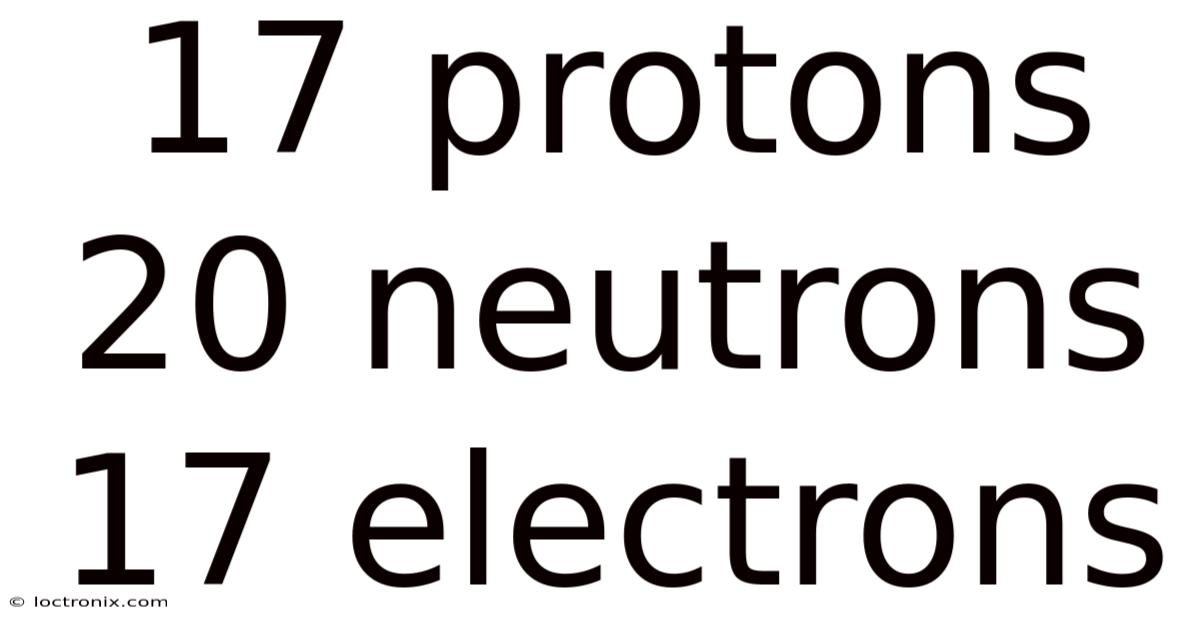
17 protons,20 neutrons, and 17 electrons. This specific combination defines the atomic structure of Chlorine-37 (Cl-37), a significant isotope of the chemical element chlorine. Understanding this configuration unlocks insights into atomic behavior, chemical properties, and the fascinating world of isotopes. Let’s delve into the details.
Introduction
The fundamental building blocks of matter are atoms, each defined by the number of protons, neutrons, and electrons they contain. The atomic number, equal to the number of protons, uniquely identifies an element. For chlorine, this number is 17. When an atom also contains 20 neutrons and 17 electrons, it forms the isotope Chlorine-37. This specific isotope plays a crucial role in various scientific and industrial applications, from medical diagnostics to water treatment. This article explores the atomic structure, properties, and significance of Chlorine-37, providing a comprehensive understanding of this essential isotope.
Atomic Structure: The Core Components
Atoms consist of a dense nucleus surrounded by a cloud of electrons. The nucleus itself is composed of protons and neutrons.
- Protons (17): These positively charged particles reside in the nucleus. The number of protons determines the element's identity. Chlorine, with its 17 protons, is classified as a halogen in the periodic table, occupying Group 17.
- Neutrons (20): These neutral particles, also found within the nucleus, contribute significantly to the atom's mass but have no charge. The specific number of neutrons (20) distinguishes Chlorine-37 from other chlorine isotopes like Chlorine-35 (17 protons + 18 neutrons).
- Electrons (17): These negatively charged particles orbit the nucleus in specific energy levels or shells. For a neutral atom, the number of electrons equals the number of protons, ensuring the atom has no overall electrical charge. In Chlorine-37, this balance is 17 electrons.
Properties and Significance
The combination of 17 protons, 20 neutrons, and 17 electrons gives Chlorine-37 distinct physical and chemical properties:
- Mass Number (A): The mass number is the sum of protons and neutrons (17 + 20 = 37). This is the number written as a superscript to the left of the element symbol (Cl-37).
- Atomic Mass: While the mass number is 37, the actual atomic mass of Chlorine-37 is very close to this value (36.966 atomic mass units). It differs slightly due to the binding energy of the nucleus.
- Stability: Chlorine-37 is a stable isotope. Unlike radioactive isotopes, it does not undergo spontaneous decay. This stability is a key factor in its usefulness.
- Chemical Behavior: Chlorine-37 behaves chemically identical to other chlorine atoms because chemical reactions are primarily governed by the electron configuration. The 17 electrons surrounding the nucleus dictate how Cl-37 interacts with other atoms and molecules. This means Cl-37 participates in the same chemical reactions as natural chlorine, forming compounds like sodium chloride (table salt), hydrochloric acid (HCl), and numerous organic chlorinated compounds.
- Physical Properties: Its physical properties, such as density and melting/boiling points, are also characteristic of chlorine isotopes. Chlorine-37 is slightly heavier than Chlorine-35 due to the extra neutron.
Isotopes of Chlorine: A Broader Context
Chlorine has two stable isotopes: Chlorine-35 (17 protons + 18 neutrons) and Chlorine-37 (17 protons + 20 neutrons). The natural abundance of these isotopes is approximately 75.77% for Cl-35 and 24.23% for Cl-37. This mixture is what we refer to as "natural chlorine." The presence of both isotopes means that samples of chlorine contain atoms with slightly different masses (35 and 37), but identical chemical behavior.
Applications and Importance of Chlorine-37
The stability and chemical similarity of Chlorine-37 make it invaluable:
- Medical Imaging and Tracers: Cl-37 is used in the production of radioactive tracers. When incorporated into molecules, it allows scientists to track biological processes non-invasively using techniques like Positron Emission Tomography (PET) scans. While other isotopes like Carbon-11 or Fluorine-18 are more common for PET, Cl-37 serves specific diagnostic purposes.
- Neutron Activation Analysis: This analytical technique involves bombarding a sample with neutrons, causing certain atoms (like Cl-37) to become radioactive. By measuring the characteristic gamma rays emitted, scientists can identify and quantify trace elements in materials, including environmental samples and archaeological artifacts.
- Water Treatment: Chlorine (primarily Cl-35 and Cl-37) is a primary disinfectant used to kill pathogens in drinking water and swimming pools. Understanding the specific isotopes helps in studying the persistence and behavior of chlorine compounds in water systems.
- Research: Cl-37 is used in fundamental research in nuclear physics, chemistry, and geochemistry to study atomic structure, nuclear reactions, and elemental distribution.
FAQ
- Q: Is Chlorine-37 radioactive? A: No, Chlorine-37 is a stable isotope. It does not undergo radioactive decay.
- Q: How does Chlorine-37 differ from regular chlorine? A: Chemically, it behaves identically to other chlorine atoms due to its identical electron count. The main difference is its slightly higher mass (36.966 amu vs. 35.45 amu for natural chlorine, which is a weighted average of Cl-35 and Cl-37). It is also less abundant than Cl-35 in nature.
- Q: Why is the number of electrons important? A: The number of electrons determines the atom's chemical properties and reactivity. In a neutral atom, the number of electrons equals the number of protons, balancing the positive and negative charges. Chlorine-37 has 17 electrons, defining its chemical behavior.
- Q: What is the mass number of Chlorine-37? A: The mass number is 37, calculated as the sum of protons (17) and neutrons (20).
Conclusion
The atomic configuration of 17 protons, 20 neutrons, and 17 electrons precisely defines the isotope Chlorine-37. While chemically indistinguishable from other chlorine atoms due to its electron count, its specific mass (37) and stability mark it as a unique isotope with significant practical applications. From enabling medical diagnostics through tracer techniques to playing a role in environmental analysis and water treatment, Cl-37 exemplifies how subtle differences in nuclear composition translate into tangible real-world importance. Understanding this fundamental atomic structure provides a foundation for appreciating the diverse roles isotopes play in science and technology.
Conclusion
The atomic configuration of 17 protons, 20 neutrons, and 17 electrons precisely defines the isotope Chlorine-37. While chemically indistinguishable from other chlorine atoms due to its electron count, its specific mass (37) and stability mark it as a unique isotope with significant practical applications. From enabling medical diagnostics through tracer techniques to playing a role in environmental analysis and water treatment, Cl-37 exemplifies how subtle differences in nuclear composition translate into tangible real-world importance. Understanding this fundamental atomic structure provides a foundation for appreciating the diverse roles isotopes play in science and technology.
In essence, Chlorine-37 represents a fascinating intersection of nuclear physics and chemical properties. Its stability and unique mass make it invaluable in a wide array of scientific disciplines. As research continues to delve deeper into the intricacies of isotopes, we can anticipate even more innovative applications emerging from these seemingly small variations in atomic structure. The story of Chlorine-37 is a potent reminder that the world around us is filled with hidden complexity, waiting to be unveiled through careful observation and scientific inquiry.
Building on the foundational understanding of Chlorine‑37’s nuclear makeup, scientists have developed several methods to isolate and enrich this isotope for specialized uses. Gas‑centrifuge cascades and laser‑based selective excitation are among the most efficient techniques, allowing the production of Cl‑37‑enriched chlorine gas with purities exceeding 99 %. This enriched material serves as a precursor for synthesizing labeled compounds, such as chloro‑organic molecules where the chlorine atom acts as a stable isotopic tag. In metabolic studies, incorporating Cl‑37 into pharmaceuticals enables researchers to trace drug pathways with mass spectrometry, offering insights into absorption, distribution, and excretion without altering the compound’s biological activity.
Beyond the laboratory, Chlorine‑37 finds niche applications in geochronology and cosmochemistry. The ratio of Cl‑37 to Cl‑35 in certain mineral formations can reveal historical fluctuations in atmospheric chlorine sources, providing clues about past volcanic activity or changes in sea‑spray aerosols. Similarly, meteoritic analyses exploit subtle variations in chlorine isotopic composition to infer the timing of solar‑nebula processes and the differentiation of planetary bodies.
In the realm of nuclear technology, Cl‑37’s relatively low neutron‑capture cross‑section makes it a useful component in neutron‑detector materials and shielding designs. When incorporated into certain scintillators, the isotope contributes to stable background signals, improving the precision of radiation measurements in both medical imaging and high‑energy physics experiments.
Environmental monitoring also benefits from Cl‑37‑based tracers. By releasing a known quantity of Cl‑37‑labeled chloride into water systems, hydrologists can map flow paths, assess contaminant transport, and evaluate the effectiveness of remediation strategies. The isotopic label remains detectable even at trace levels, allowing researchers to study processes that would be obscured by the abundant natural chlorine background.
As analytical instruments continue to advance—particularly high‑resolution mass spectrometers and laser‑spectroscopy tools—the capacity to exploit minute isotopic differences expands. Chlorine‑37 exemplifies how a seemingly modest shift in neutron count can unlock a spectrum of practical innovations, from improving diagnostic accuracy to refining our understanding of Earth’s geological history. Continued interdisciplinary collaboration will likely uncover further applications, reinforcing the idea that isotopic diversity is a powerful lever for scientific and technological progress.
Conclusion
The unique combination of 17 protons, 20 neutrons, and 17 electrons that defines Chlorine‑37 translates into a stable, heavy isotope with versatile utility across medicine, environmental science, geochemistry, and nuclear technology. Its ability to serve as an inert yet detectable label enables precise tracing of chemical and physical processes without perturbing the system under study. As detection methods grow more sensitive and production techniques more refined, the role of Chlorine‑37 will undoubtedly expand, offering new avenues for discovery and innovation. Ultimately, Chlorine‑37 underscores a fundamental principle: subtle variations in an atom’s nucleus can yield profound impacts on the macroscopic world, reminding us that the quest to understand isotopic nuances remains a vibrant frontier in science.
Latest Posts
Latest Posts
-
What Are The Different Point Of Views
Mar 21, 2026
-
Water And Chlorobenzene Are Immiscible Liquids
Mar 21, 2026
-
How Long Is Ap Physics 1 Exam
Mar 21, 2026
-
What Do Transverse Waves Look Like
Mar 21, 2026
-
Which Tool Is Used To Measure Mass
Mar 21, 2026
