17 Protons 18 Neutrons 17 Electrons

loctronix
Mar 17, 2026 · 6 min read
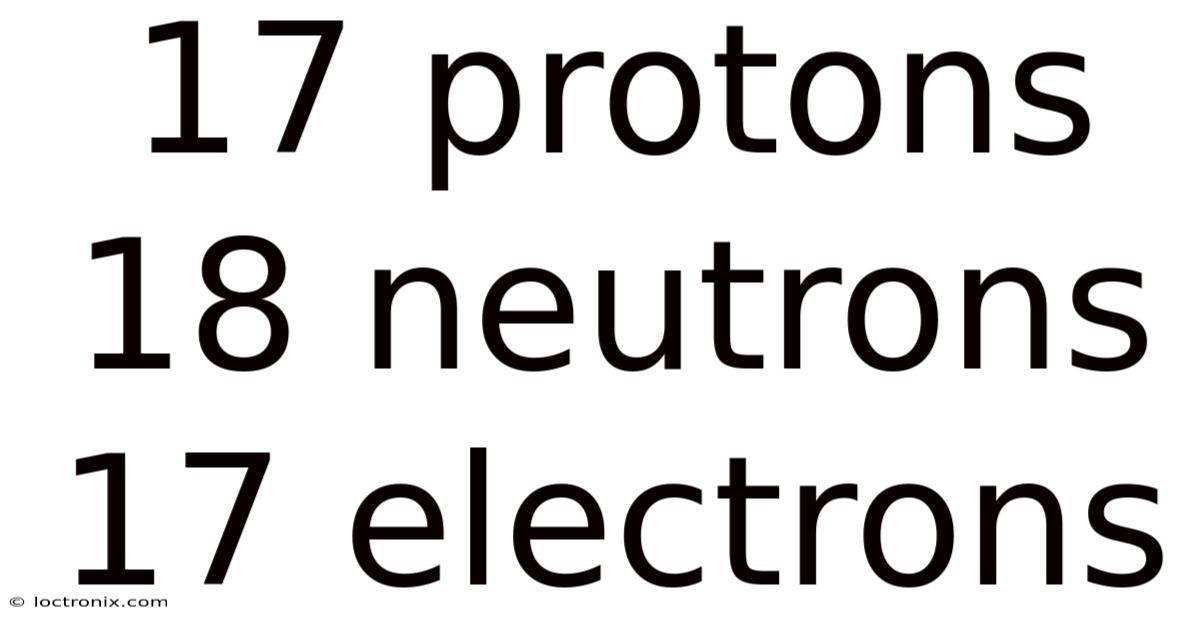
Table of Contents
17 protons, 18 neutrons,17 electrons. This specific combination defines a fundamental building block of matter: a chlorine atom in its most common stable form. Understanding the significance of these subatomic particles – protons, neutrons, and electrons – and how their numbers dictate an atom's identity, properties, and behavior is crucial for grasping the very foundation of chemistry and the physical world. Let's dissect this atomic blueprint.
Atomic Structure: The Core Components
At the heart of every atom lies the nucleus, a dense, positively charged core. Within this nucleus reside two types of particles: protons, each carrying a single positive charge (+1), and neutrons, which are electrically neutral (no charge). Orbiting this nucleus at vast distances, in specific energy levels or shells, are the electrons. These negatively charged particles (-1) are incredibly light compared to protons and neutrons, their mass being negligible in atomic mass calculations.
The defining characteristic of an element is determined solely by the number of protons within its nucleus. This number is called the atomic number. For the atom described – 17 protons – its atomic number is 17. This means it belongs to the chemical element chlorine (Cl). The atomic number dictates the element's position on the periodic table and fundamentally influences its chemical behavior.
Calculating the Neutrons: Finding the Mass Number
While the atomic number tells us the number of protons, it doesn't directly reveal the number of neutrons. Neutrons contribute significantly to the atom's mass but not its charge. To find the neutron count, we need the mass number (A), which is the total number of protons and neutrons combined within the nucleus.
The mass number is calculated as follows:
Mass Number (A) = Number of Protons + Number of Neutrons
Given that the atom has 17 protons and 18 neutrons, we can calculate its mass number:
Mass Number (A) = 17 + 18 = 35
Therefore, this chlorine atom has a mass number of 35. This specific isotope of chlorine is commonly referred to as chlorine-35. The notation for this isotope is Cl-35.
Electron Configuration: The Balancing Act
The atom is described as having 17 electrons. For a neutral atom (which has no overall electrical charge), the number of electrons must always equal the number of protons. Here, 17 protons and 17 electrons confirm the atom is neutral. The arrangement of these electrons around the nucleus follows specific rules and determines the atom's chemical properties.
Electrons occupy distinct energy levels or shells around the nucleus, designated as K, L, M, N, etc., or numerically as 1, 2, 3, 4, etc. The maximum number of electrons each shell can hold is given by the formula 2n², where n is the shell number.
- The first shell (n=1) holds a maximum of 2 electrons.
- The second shell (n=2) holds a maximum of 8 electrons.
- The third shell (n=3) holds a maximum of 18 electrons, but for the first 20 elements, it typically holds up to 8 electrons in the ground state.
For chlorine (atomic number 17), the electron configuration follows the order dictated by the Aufbau principle:
- 1s² (2 electrons)
- 2s² (2 electrons, total 4)
- 2p⁶ (6 electrons, total 10)
- 3s² (2 electrons, total 12)
- 3p⁵ (5 electrons, total 17)
Therefore, the electron configuration of a neutral chlorine atom is 1s² 2s² 2p⁶ 3s² 3p⁵. This configuration places 7 electrons in the outermost shell (the third shell, n=3). This valence electron configuration (3s² 3p⁵) is highly significant. It means chlorine has 7 valence electrons, just one electron short of a stable, full outer shell (which would hold 8 electrons). This inherent "electron hunger" is the driving force behind chlorine's highly reactive chemical behavior, making it a powerful oxidizing agent that readily forms ionic compounds (like table salt, NaCl) by gaining one electron to achieve a stable configuration similar to argon.
Properties and Significance
This specific atom, Cl-35, exhibits the fundamental properties of chlorine:
- Atomic Number (Z): 17 - Defines it as chlorine.
- Mass Number (A): 35 - Gives it a specific isotopic identity.
- Atomic Mass: Approximately 34.97 u (unified atomic mass units), reflecting the combined mass of its 17 protons and 18 neutrons, plus the negligible mass of its 17 electrons.
- Electrical Charge: Neutral (0), due to equal numbers of positive protons and negative electrons.
- Chemical Behavior: Driven by its 7 valence electrons (3s² 3p⁵), it seeks to gain one electron to achieve the stable noble gas configuration of argon (1s² 2s² 2p⁶ 3s² 3p⁶). This makes it a strong oxidizing agent and highly reactive, especially in forming ionic bonds.
Isotopes: Variations on a Theme
While all chlorine atoms have 17 protons (defining them as chlorine), the number of neutrons can vary. This leads to different isotopes. The most abundant isotope of chlorine is Cl-35 (17 protons, 18 neutrons), making up about 75.77% of naturally occurring chlorine. Another significant isotope
Beyond these fundamental properties, chlorine exhibits isotopic diversity. The other major stable isotope is Cl-37, with 17 protons and 20 neutrons, accounting for approximately 24.23% of natural chlorine. The existence of these two primary isotopes, Cl-35 and Cl-37, is the reason chlorine’s standard atomic weight is not a whole number but a weighted average of approximately 35.45 u. This isotopic variation, while subtle in bulk chemical behavior, becomes critically important in fields like mass spectrometry, geochemistry, and tracer studies, where the slight mass difference allows scientists to track chlorine’s movement through environmental and biological systems.
The story of a single chlorine atom, therefore, encapsulates core principles of atomic structure. Its defining characteristic—the 7 valence electrons in the 3s and 3p subshells—dictates a powerful tendency to gain one electron, achieving a stable octet. This electron-driven imperative makes chlorine an exceptionally vigorous nonmetal, a relentless oxidizer that forms salts, disinfectants, and countless organic compounds. Its isotopic composition adds a layer of complexity to its physical mass but does not alter this fundamental chemical personality. Thus, from the arrangement of its 17 electrons to the mixture of its nuclei, chlorine exemplifies how atomic structure governs the reactivity and utility of an element.
Conclusion
In summary, the chlorine atom, with its atomic number of 17 and characteristic electron configuration of 1s² 2s² 2p⁶ 3s² 3p⁵, is chemically defined by its seven valence electrons. This configuration creates a pronounced electron affinity, driving its high reactivity and role as a strong oxidizing agent. The natural occurrence of two stable isotopes, Cl-35 and Cl-37, fine-tunes its atomic mass without changing its essential chemical behavior. Ultimately, chlorine’s position in the periodic table and its specific electronic structure explain its pervasive and vital, yet often corrosive, presence in both the inorganic world and the fabric of life.
Conclusion
In summary, the chlorine atom, with its atomic number of 17 and characteristic electron configuration of 1s² 2s² 2p⁶ 3s² 3p⁵, is chemically defined by its seven valence electrons. This configuration creates a pronounced electron affinity, driving its high reactivity and role as a strong oxidizing agent. The natural occurrence of two stable isotopes, Cl-35 and Cl-37, fine-tunes its atomic mass without changing its essential chemical behavior. Ultimately, chlorine’s position in the periodic table and its specific electronic structure explain its pervasive and vital, yet often corrosive, presence in both the inorganic world and the fabric of life. Its remarkable properties, stemming from its electron arrangement and isotopic variations, underscore the fundamental relationship between atomic structure and the chemical behavior of elements. Understanding chlorine, therefore, provides a valuable insight into the broader principles governing the world around us.
Latest Posts
Latest Posts
-
Example Essay Of Compare And Contrast Introduction
Mar 17, 2026
-
Which Angle Is Complementary To 3
Mar 17, 2026
-
Do All Organic Compounds Contain Carbon
Mar 17, 2026
-
Ap English Language And Composition Essays
Mar 17, 2026
-
Which Compound Does H2so4 Represent When In An Aqueous Solution
Mar 17, 2026
Related Post
Thank you for visiting our website which covers about 17 Protons 18 Neutrons 17 Electrons . We hope the information provided has been useful to you. Feel free to contact us if you have any questions or need further assistance. See you next time and don't miss to bookmark.
